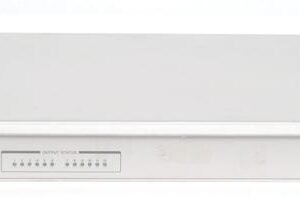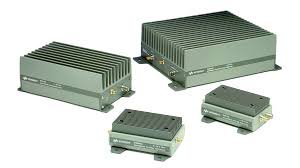
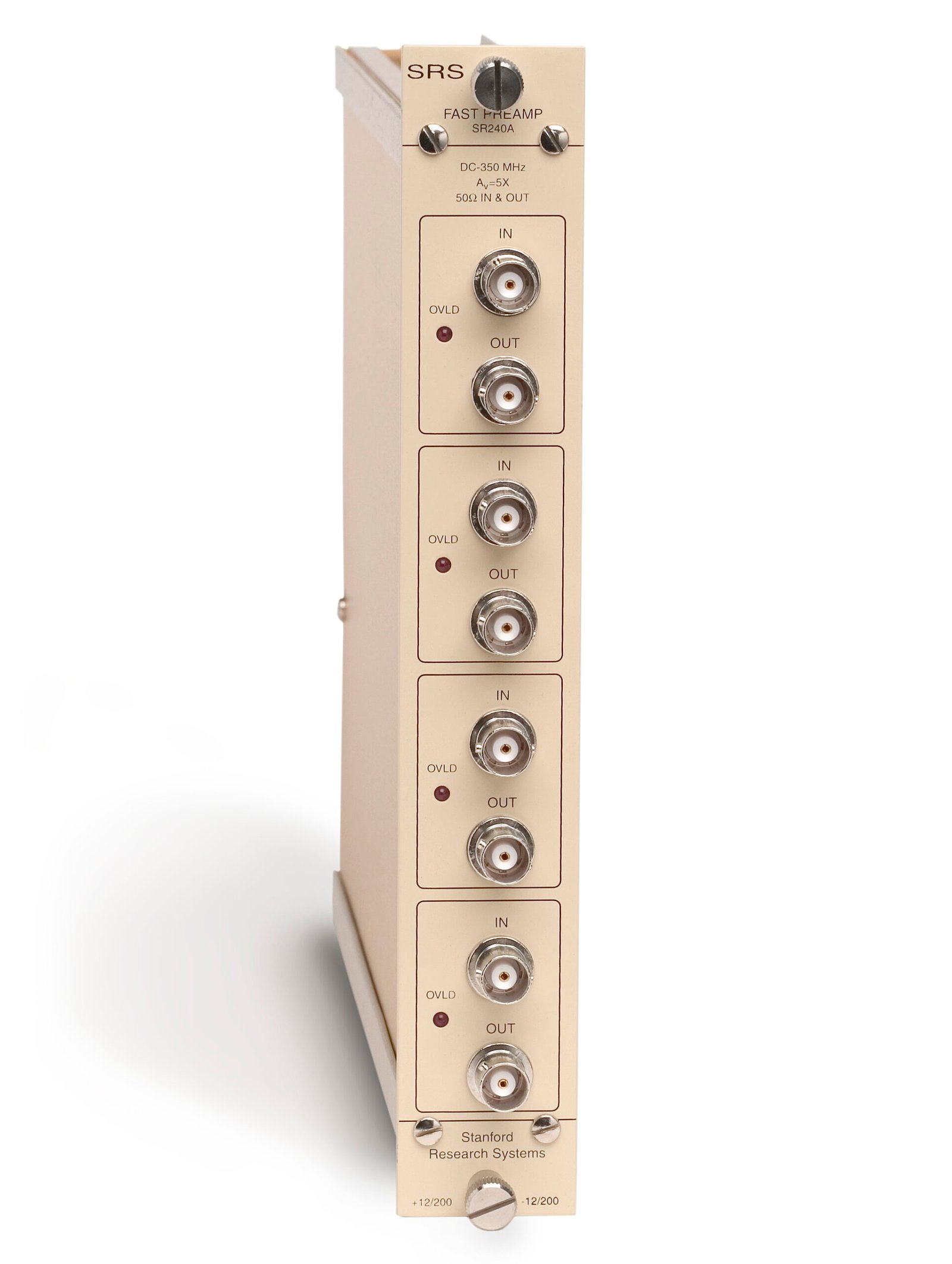

The Stanford Research Systems SR240 is a four-channel preamplifier engineered for amplification of low-level signals across DC to 300 MHz. Each channel delivers 5× gain independently, with cascaded configurations achieving gains of 25, 125, or 625. The unit operates at 50 Ω input/output impedance with 1 ns rise/fall time, 6.4 nV/√Hz input noise, and 3 ns overload recovery. Phase linearity is excellent across the operating bandwidth. DC coupling enables measurement of both AC and DC components. The SR240 integrates directly with photomultiplier tubes, photodiodes, and downstream instruments such as the SR250 boxcar averager, making it ideal for RF measurements, signal recovery, and sensor amplification.
Technical Specifications
• Bandwidth: DC to 300 MHz
• Gain per Channel: 5 (independent operation)
• Cascaded Gains: 5, 25, 125, 625
• Input/Output Impedance: 50 Ω
• Input Noise: 6.4 nV/√Hz
• Rise/Fall Time: 1 ns
• Overload Recovery: 3 ns
• Coupling: DC-coupled
• Number of Channels: 4
– Key Features
• Four independent channels with selectable gain architecture
• Low noise performance essential for weak signal recovery
• Fast transient response with 1 ns rise/fall time
• Rapid overload recovery at 3 ns ensures minimal signal loss during transients
• Standard 50 Ω impedance compatibility with RF test equipment
• Excellent phase linearity across full bandwidth
– Typical Applications
• Photomultiplier tube signal conditioning
• Photodiode amplification
• RF signal recovery and measurement
• Low-level sensor signal preprocessing
• Integration with lock-in amplifiers and boxcar averagers
– Compatibility & Integration
The SR240 connects directly to Stanford Research Systems instruments, particularly the SR250 gated integrator and boxcar averager, for enhanced signal measurement capabilities. Standard RF connectors (BNC) support integration with existing test benches and measurement systems.