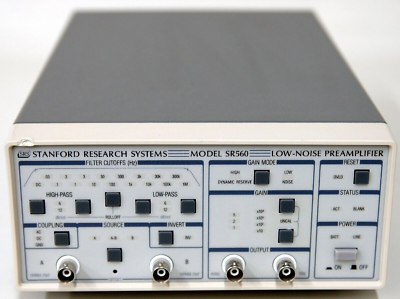

The Stanford Research SR560 is a low-noise voltage preamplifier engineered for amplification of small signals in demanding measurement environments. It delivers input-referred noise below 4 nV/√Hz at 1 kHz and operates across a DC to 1 MHz bandwidth, making it ideal for low-temperature measurements, optical detection, and precision signal recovery. The instrument features true differential inputs with floating BNC shields, selectable AC or DC coupling, and dual output stages—a 600 Ω and 50 Ω BNC connector—each capable of driving 10 Vpp into their respective loads.
Technical Specifications
• Bandwidth: DC to 1 MHz (−3 dB at 1.2 MHz typical)
• Input Noise: 90 dB to 1 kHz, decreasing 6 dB/octave above 1 kHz; 100 dB DC to 1 kHz
• Gain Range: 1 to 50,000 selectable in 1-2-5 sequence; vernier control ±0.5% resolution
• Gain Stability: 200 ppm/°C
• DC Drift: 5 µV/°C (referred to input, DC coupled)
• Low-Pass/High-Pass Filters: First-order RC configuration; 6 dB/octave or 12 dB/octave rolloff; band-pass 6 dB/octave; cutoff 0.03 Hz to 1 MHz in 1-3-10 sequence
• Outputs: 600 Ω and 50 Ω BNC connectors; 10 Vpp maximum into respective loads
– Key Features
• Dual-mode gain allocation: Low Noise Mode places gain at front-end; High Dynamic Reserve Mode allocates gain post-filter to prevent overload
• Filter reset button on front panel for overload recovery with long time constants
• Configurable input coupling and filter topology for signal conditioning
– Typical Applications
• Low-temperature measurements
• Optical detection
• Audio engineering
• Scientific and industrial signal measurement in high-noise environments
– Compatibility & Integration
Benchtop or half-rack form factor. Differential and single-ended input support accommodates diverse sensor configurations.