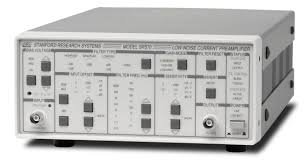

The Stanford Research Systems SR570 is a low-noise current preamplifier engineered to amplify small AC currents with high precision across applications spanning low-temperature physics, electrochemistry, and materials research. It delivers 5 fA/√Hz input noise and supports maximum gain of 1 pA/V with bandwidth to 1 MHz, making it suitable for sensitive current measurements in demanding experimental environments.
Technical Specifications
• Input Noise: 5 fA/√Hz
• Maximum Gain: 1 pA/V
• Maximum Bandwidth: 1 MHz
• Maximum Input Current: ±5 mA
• Input Offset Current: Adjustable ±1 pA to ±1 mA in approximately 0.1% increments; on/off switchable
• Input DC Bias Voltage: Adjustable ±5 V
• Gain Range: 1 pA/V to 1 mA/V in 1-2-5 sequence with vernier adjustment (0.5% or 1% steps)
• Filter Cutoff Frequencies: 0.03 Hz to 1 MHz in 1-3-10 sequence
• AC Power Input: 100 V, 120 V, 220 V, or 240 V nominal (50 or 60 Hz)
• Battery Operation: Three rechargeable lead-acid batteries; up to 15 hours runtime with internal charger
– Key Features
• Three gain allocation modes optimize performance: Low-Noise Mode places gain at the front end; High-Bandwidth Mode allocates gain to later stages; Low-Drift Mode reduces DC drift by a factor of 1000 using very low input-current op-amps
• Dual configurable first-order RC filters support low-pass, high-pass (6 or 12 dB/octave), and band-pass (6 dB/octave) configurations with filter reset for accelerated overload recovery
• Front-panel source capacitance compensation adjustable to correct frequency response effects
• Fully floating amplifier ground with amplifier and chassis ground available at rear connectors
• RS-232 interface (opto-isolated, 9600 baud, DCE format) enables remote control of all functions except power
• Two opto-isolated TTL inputs provide blanking (gain on/off control) and toggling (synchronous detection via gain sign inversion)
– Typical Applications
Low-temperature physics, electrochemistry, materials research, and experiments requiring sub-picoampere current sensitivity.
– Compatibility & Integration
RS-232 connectivity supports integration into automated measurement systems. Opto-isolation on all signal inputs ensures immunity to ground loops and external noise sources. Battery operation enables deployment in electromagnetically sensitive environments.