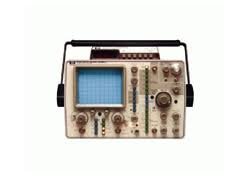

The Tektronix 2225 is a 50 MHz, two-channel analog oscilloscope designed for general-purpose signal analysis in educational, field service, and production environments. Its high-resolution CRT display delivers clear waveform visualization across a 8×10 division graticule. With vertical sensitivity from 2 mV/div to 5 V/div, adjustable time-base speeds from 0.05 µs/div to 0.5 s/div, and flexible trigger options, the instrument supports AC, DC, and component testing workflows. Engineers and technicians benefit from straightforward operation and ±3% measurement accuracy on both vertical and horizontal axes.
Technical Specifications
Oscilloscope Core
• Bandwidth: 50 MHz
• Channels: 2
• Vertical sensitivity: 2 mV/div to 5 V/div
• Vertical modes: CH1, CH2, DUAL, ADD
• Input coupling: AC, GND, DC
• Input impedance: 1 MΩ ± 2% (approximately 15 pF)
• Maximum input voltage: 400 V peak-to-peak (10X attenuation); 200 V peak-to-peak (1X attenuation). Derate at 5 V/ns.
Horizontal System
• Time-base range: 0.05 µs/div to 0.5 s/div
• Sweep modes: AUTO, NORMAL, SINGLE SWEEP
Trigger System
• Modes: AUTO, NORMAL, SINGLE
• Sources: CH1, CH2, ALT, EXT, EXT/5
• Coupling: AC, DC, LF Reject, HF Reject, Noise Reject
• Holdoff: 2 to 10 divisions continuously variable
Display & Accuracy
• CRT with illuminated internal graticule (8×10 divisions)
• Vertical accuracy: ±3%
• Horizontal accuracy: ±3%
• Bandwidth limit: 20 MHz
Power
• 90–250 VAC, 45–440 Hz, 50 VA maximum
– Key Features
• Component tester with 5 V peak-to-peak test signal for in-circuit and out-of-circuit measurement
• Probe compensation output: 1 kHz ± 1% square wave with adjustable amplitude
• BNC connectors on all signal inputs and outputs
– Typical Applications
Signal integrity verification in analog circuits, troubleshooting in field service, educational laboratory measurements, and production-line testing of analog systems.
– Compatibility & Integration
Works with standard Tektronix passive voltage probes offering 1X and 10X attenuation and 1 MΩ input impedance. BNC-based signal architecture supports external trigger sources and standard instrumentation integration.