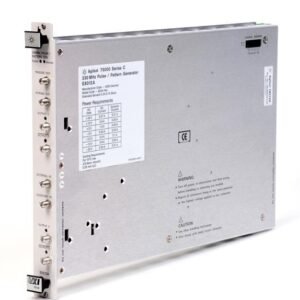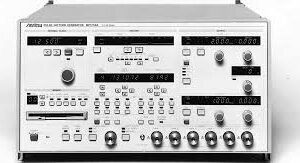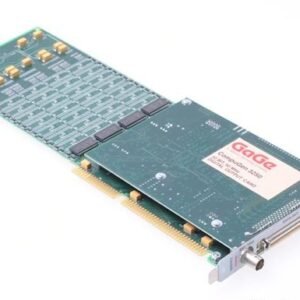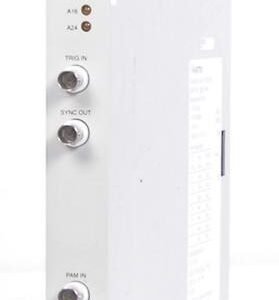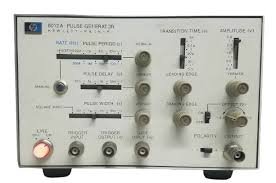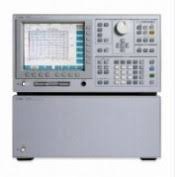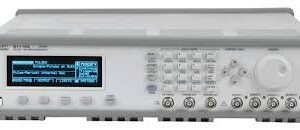

The Tektronix DG2030A is a digital data pattern generator designed for high-speed digital and communication systems testing. It delivers precise signal generation across up to 400 Mb/s data rates with pattern depths to 256 Kbits per channel, available in 4- or 8-channel configurations. The instrument provides flexible output amplitude control, precise timing adjustments, and advanced sequence control with event triggering and nested loop capabilities—making it suitable for complex validation and characterization of modern digital designs.
Technical Specifications
• Data Rate: Up to 400 Mb/s
• Pattern Depth: 256 Kbits per channel
• Output Channels: 4 or 8 channels
• Output Amplitude: 500 mVp-p to 9 Vp-p (into high impedance); 250 mVp-p to 5 Vp-p into 50 Ω; VOH/VOL ranges from -1.50 V to +3.50 V into 50 Ω
• Rise/Fall Time: 1.5 ns (20%–80%) at 2.5 Vp-p; variable 2.1 ns to 4.7 ns at 3.00 Vp-p; 500 ps fast transition at 0.25–1 Vp-p
• Timing Resolution: 100 ps control resolution; 20 ps delay adjustment resolution; ±1 ns de-skew range with 10 ps steps
• Trigger Input (Front Panel): -5.0 V to +5.0 V, 0.1 V resolution, 1 kΩ or 50 Ω impedance, threshold accuracy ±(5% of setting) ±0.1 V
• Event Input (Rear Panel): -5.0 V to +5.0 V threshold, 0.1 V resolution, 100 ns minimum pulse width
• Inhibit Input (Rear Panel): -5.0 V to +5.0 V, 0.1 V resolution, 34–38 ns delay to data output
• Clock Output (Front Panel): 36 ns typical delay
• Delay Function: CH 0 to CH 7, -5 ns to 18 ns delay range, 20 ps resolution
– Key Features
• Flexible sequence control with jump, event, and nested loop operations
• Advanced sequence editing for fault and glitch insertion
• Graphical user interface with large display for data editing and monitoring
• Independent delay control per channel with picosecond resolution
• Configurable output impedance and amplitude control in 100 mV or 5 mV steps
– Typical Applications
Digital design validation, communication system characterization, high-speed digital bus testing, and protocol-level signal generation for complex test scenarios.