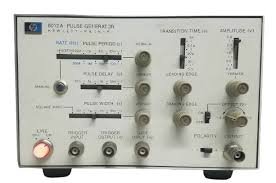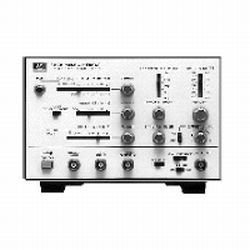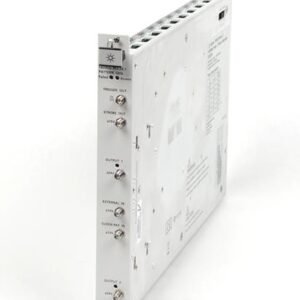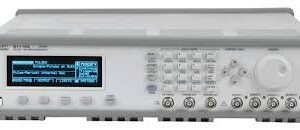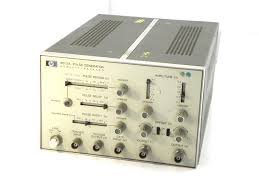
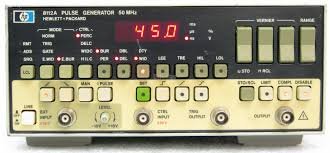

The HP 8112A is a programmable pulse generator delivering precise pulse control from 1 Hz to 50 MHz. Engineers rely on it for digital circuit characterization, signal simulation, and complex timing applications requiring nanosecond-level accuracy. Programmable via HP-IB (IEEE 488), the instrument provides independent control of pulse width, delay, duty cycle, and output levels across multiple operating modes—making it ideal for validation and troubleshooting workflows.
Technical Specifications
Frequency & Timing
• Frequency range: 1 Hz to 50 MHz
• Pulse width: 10.0 ns to 950 ms (±5% of programmed value ±2 ns)
• Pulse delay: 75.0 ns to 950 ms (±5% of programmed value ±4 ns)
• Period: 20.0 ns to 950 ms
• Double pulse spacing: 20.0 ns to 950 ms
• Duty cycle: 1% to 99% (±10% of programmed value)
Output Levels
• Maximum amplitude (open circuit): 32 Vpp
• Maximum amplitude (50 Ω load): 16 Vpp
• High level: −7.90 V to +8.00 V (±1% of programmed value ±3% amplitude ±40 mV)
• Low level: −8.00 V to +7.90 V (±1% of programmed value ±3% amplitude ±40 mV)
• Output impedance: 50 Ω ±5%
Transition Control
• Fixed transitions: 5 ns typical
• Variable transitions (linear and cosine): 6.5 ns to 95.0 ms (±5% of programmed value ±2 ns)
• Settling time: 100 ns + transition time
– Key Features
• Five operating modes: Normal, Trigger, Gate, External Width, and External Burst (1–1999 pulses)
• Modulation control for Period, Delay, Width, and Upper Level; 3-level signal generation supported
• Nine programmable memory locations for parameter set storage and recall
• Full HP-IB programmability with IEEE 488 support (SRI, AHI, T6, PPO, DCI, DTI)
• Repeatability factor 4 better than rated accuracy specifications
– Typical Applications
Digital circuit validation, timing subsystem testing, pulse train simulation, and gate-signal generation for complex test sequences.
– Compatibility & Integration
HP-IB (IEEE 488) interface enables remote instrument control and automated test sequences. Operates across 100–240 V AC input; power consumption 48–120 VA max.