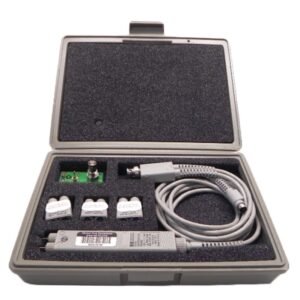
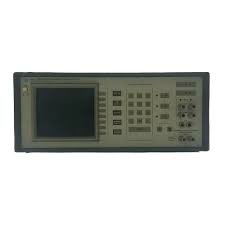

The HP/Agilent 4945A Transmission Impairment Measurement Set (TIMS) is a bench-top instrument for measuring transmission parameters across voice, data, and broadcast circuits. It performs level, frequency, noise, and distortion analysis from 20 Hz to 110 kHz and supports digital data services testing up to 56 kbps. The 4945A enables installation, maintenance, and troubleshooting of telecommunication networks with master/slave capability for remote, end-to-end automated testing.
Technical Specifications
The instrument measures across a 20 Hz to 110 kHz frequency range with receiver sensitivity from −60 dBm to +13 dBm. Noise measurement spans 10 to 90 dBm for message circuit and noise-with-tone, and 40 to 130 dBm for noise-to-ground. Signal-to-noise ratio range is 10 to 45 dB. Selectable impedances include 135 Ω, 600 Ω, 900 Ω, and 1200 Ω.
Filtering options comprise C-message, 3 kHz, 15 kHz, program, and 50 kbit noise filters, plus a notch filter with 50 dB rejection from 995 to 1025 Hz. Power requirements are 115/230 V ac (±11% to −22%), 48 to 63 Hz, maximum 150 W; Option 001 provides 100/200 V operation.
– Key Features
• Measures attenuation distortion, envelope delay distortion, and gain slope
• Analyzes message circuit noise with multiple filter selections
• Detects phase jitter, amplitude jitter, and intermodulation distortion (with S/N correction)
• Identifies gain hits, phase hits, 3-level impulse noise, and dropouts
• Calculates peak-to-average ratio and 2/4-wire return loss (ERL, SRL Hi, SRL Lo, sine)
• Master/slave configuration enables remote unit control and automated end-to-end testing
• Nonglare CRT display with membrane switch keyboard
• Flexible mounting: vertical, horizontal, or rack-mount configurations
– Typical Applications
The 4945A is suited for installation, maintenance, and troubleshooting of voice and data transmission circuits. It qualifies for testing Dataphone Digital Service (DDS) local distribution loops up to 56 kbps.
– Compatibility & Integration
The instrument complies with Pub 41009, IEEE 743-1984, and current Bell standards. Optional interface modules (up to two) support HP-IB (Option 101), RS-232-C (Option 102), and HP-IL (Option 103) communication with external controllers, enabling integration into automated test systems.