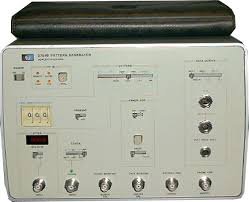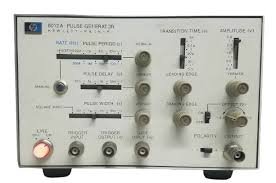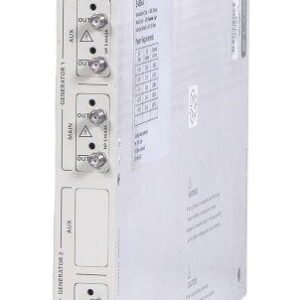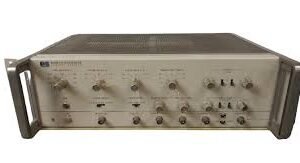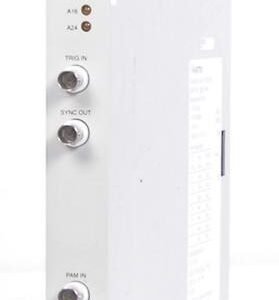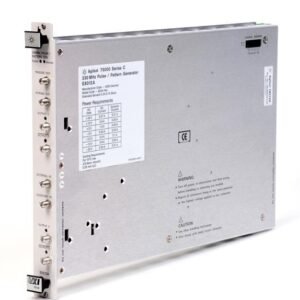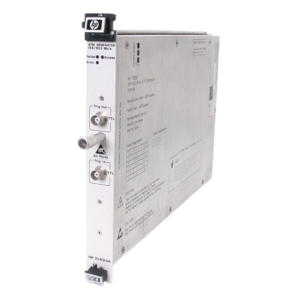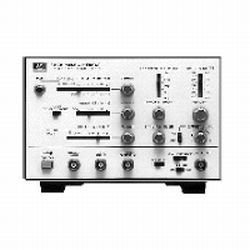
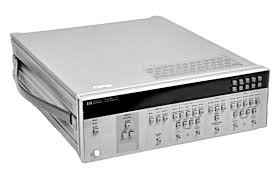

The HP/Agilent 8133A is a 3 GHz pulse generator engineered for high-speed digital and communications testing. It delivers precise, programmable control of pulse parameters—period, width, delay, amplitude, and transition times—with minimal jitter for signal integrity in demanding test scenarios. The instrument generates programmable data patterns and PRBS sequences, supporting eye diagram measurements and advanced characterization. IEEE 488.1/488.2 and SCPI compliance enable seamless integration into automated test systems.
## Technical Specifications
**Frequency & Timing**
• Frequency range: 33 MHz to 3 GHz
• Programmable period: 333 ps to 30 ns
• Transition time (rise/fall): <100 ps typical, <60 ps
• Jitter: 1 ps typical, <5 ps maximum
• Internal timebase minimum: 33 MHz (all specs)
• Operation down to 3 MHz (reduced capability)
• External timebase divisors: 1, 2, 4, 8, 16, 32, 64
**Output Characteristics**
• Output amplitude: 2 Vpp AC-coupled (Channel X); 50 mV to 2 V for LVDS
• Output impedance: 50 Ω
• Connectors: SMA (f) 3.5 mm
• Programmable pulse width and delay
• Programmable interchannel delay
• Variable cross-over point for eye deformation simulation
**Data Generation (Option 002)**
• Data modes: 32-bit programmable patterns or PRBS
• PRBS: CCITT O.151 (2^23-1)
• Pattern types: NRZ and RZ (50% duty cycle)
• Trigger output: Synchronized to Bit 0 of 32-bit word
**Configuration Options**
• Single or dual channel configurations available
• Option 002: Pulse/Data Channel
• Option 003: Pulse Channel
• Non-volatile memory: Stores 20 complete instrument setups
## Key Features
• All modes and parameters fully programmable via GPIB
• Jitter emulation capability for delay modulation testing
• Transition times <100 ps ensure signal fidelity
• Channel 2 minimum frequency: 1 MHz
• Operates 0°C to 55°C
## Typical Applications
• High-speed digital circuit characterization
• Eye diagram and timing analysis
• Communications system testing
• LVDS and differential signal validation
## Compatibility & Integration
Full GPIB programmability per IEEE 488.1/488.2 and SCPI 1992.0 standards. Settings stored in non-volatile memory across power cycles.