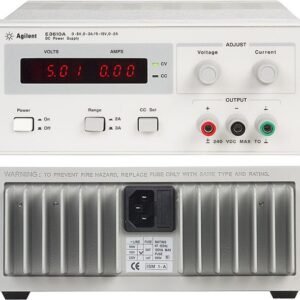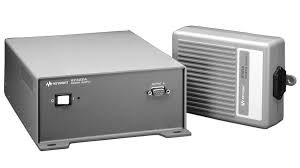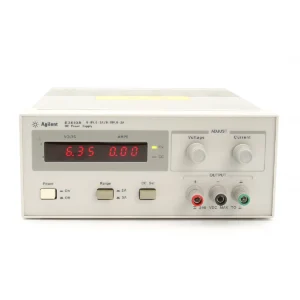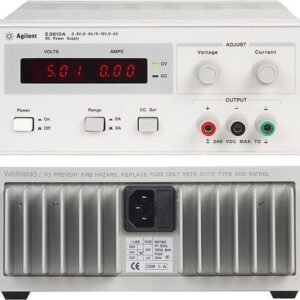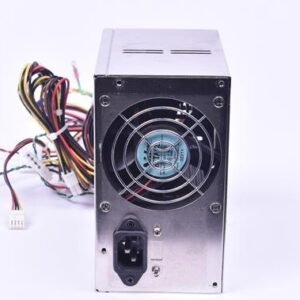
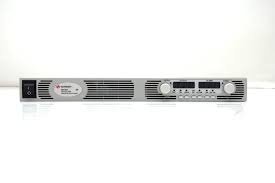

The Keysight N5745A is a 750 W single-output programmable DC power supply engineered for automated test equipment and bench applications. This 1U rackmount unit delivers 0–30 VDC at 0–25 A with universal AC input (85–265 VAC), constant voltage/constant current operation, and integrated protection against overvoltage, overcurrent, and thermal faults. Remote sensing compensates for wiring losses to maintain load accuracy. The instrument supports GPIB, LAN, and USB 2.0 interfaces with full LXI Class C compliance and includes a built-in web server for browser-based control.
Technical Specifications
Output Ratings
• Single output: 0–30 VDC, 0–25 A
• Maximum power: 750 W
• CV/CC operation with independent remote enable/disable
Electrical Characteristics
• Input: Universal 85–265 VAC; 10.5 A @ 100 VAC, 5 A @ 200 VAC
• Power factor correction: 0.99 typical
• Overvoltage, overcurrent, and overtemperature protection
• Remote sensing for load compensation
Interfaces & Control
• GPIB, LAN, USB 2.0; SCPI command set
• Analog voltage and current control; front-panel rotary encoders (coarse/fine)
• 15 user-definable memory states
• Web server interface for remote access
• Front-panel lock prevents accidental adjustment
Display & Measurement
• Digital simultaneous voltage and current readout
• LED status indicators
Physical
• 1U height, 19-inch rackmount form factor
• Front, side, and rear ventilation for stacked deployment
– Key Features
• Parallel operation up to 4 units for increased current capability
• Series operation for elevated output voltage
• Compact 1U profile suitable for ATE and benchtop setups
• 0.99 power factor correction minimizes input current draw
• Built-in web server enables remote monitoring and control
– Typical Applications
• Automated test equipment (ATE) systems
• Component and device characterization
• Power distribution in multiunit test racks
• Development and validation benches requiring programmable DC power
– Compatibility & Integration
Full SCPI support enables integration into LXI-compliant test infrastructures. Parallel and series capability allows flexible power architecture scaling. Multiple interface options—GPIB, Ethernet, and USB—accommodate legacy and modern control systems.