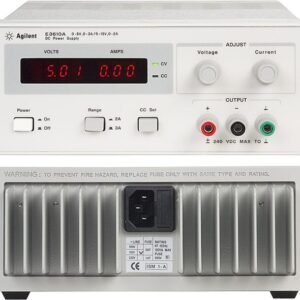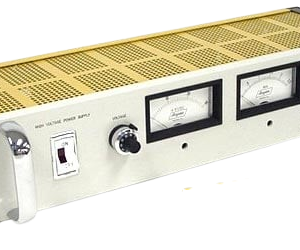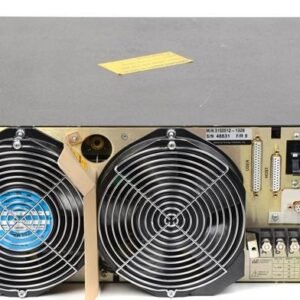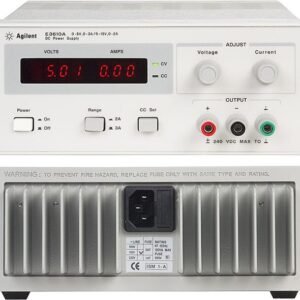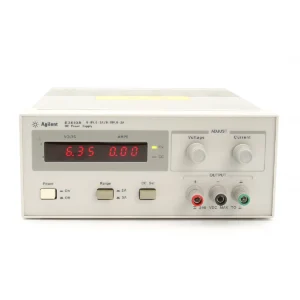
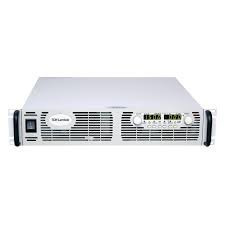

The GEN200-16.5 is a 3300 W programmable DC power supply from TDK Lambda’s Genesys™ series, delivering 0–200 Vdc at up to 16.5 A for OEM, industrial, and laboratory applications. Active power factor correction (typical 0.99) and standard RS-232/RS-485 interfaces enable flexible, networked operation. Output voltage ripple noise measures 0.07 Vrms (5 Hz to 1 MHz) with 4 mV resolution; current output resolves to 0.33 mA. The unit operates from single-phase 170–265 Vac input (47–63 Hz) at typical 83% efficiency. Adjustable over-voltage protection (OVP), under-voltage lockout (UVL), and current foldback safeguard the load. Safe Re-Start and Last Setting Memory functions ensure predictable power-up behavior. Rear-panel analog voltage and current programming accept 0–5 V or 0–10 V isolated control signals. Up to four identical units network in parallel for increased total capacity, appearing as a single supply to the operator.
## Technical Specifications
• Output: 0–200 Vdc @ 0–16.5 A, 3300 W rated
• Voltage ripple noise: 0.07 Vrms (5 Hz to 1 MHz)
• Voltage resolution: 4 mV
• Current resolution: 0.33 mA
• AC input: 170–265 Vac, single-phase, 47–63 Hz
• Efficiency: 83% typical; 88% at 100/200 VAC
• Power factor correction: 0.99 typical (active)
• Output voltage/current: Settable via RS-232/RS-485 or analog (0–5 V/0–10 V isolated inputs)
• Dimensions: 423 mm (W) × 88 mm (H) × 442.5 mm (D)
## Key Features
• Adjustable over-voltage protection (OVP) and under-voltage lockout (UVL)
• Adjustable current foldback with selectable output latching
• Front-panel encoders for voltage and current control
• Safe Re-Start and Last Setting Memory functions
• Parallel operation capability (up to four units)
• Front-panel lockout option
## Typical Applications
• Industrial test and burn-in systems
• Laboratory R&D and prototype validation
• OEM equipment integration requiring networked power
## Compatibility & Integration
Standard RS-232/RS-485 interfaces support serial configuration and monitoring. Optional LAN (LXI), GPIB, USB, and isolated analog control modules extend integration options. LabVIEW and LabWindows drivers simplify software development.