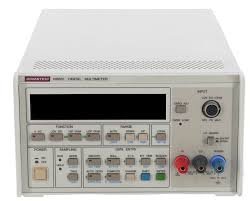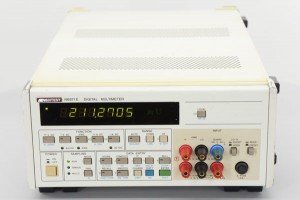

The North Atlantic 801-F3 is a precision panel meter for measuring angular position in synchro and resolver systems. It delivers 0.1° or 0.01° resolution with 0.2° or 0.03° accuracy across industrial and aerospace applications. The instrument accepts programmable line-to-line input voltages of 11.8 Vrms, 26 Vrms, or 90 Vrms and operates across 47 Hz to 1200 Hz. A Type II tracking servo loop enables zero lag tracking up to 180°/second, while transformer-isolated inputs and discrete component construction ensure signal integrity and field maintainability.
Technical Specifications
• Input: Synchro or Resolver signals
• Input Voltage (line-to-line): 11.8 Vrms, 26 Vrms, or 90 Vrms (programmable)
• Input Frequency: 47 Hz to 1200 Hz
• Reference Input Voltage: 3 Vrms to 126 Vrms
• Reference Input Impedance: 100 kΩ
• Signal Input Impedance: 1 MΩ (transformer isolated)
• Loop Gain (Ka): 400
• Resolution: 0.1° or 0.01° (selectable)
• Accuracy: 0.2° or 0.03° (available)
• Tracking Rate: 180°/second
• Display: 0.56″ digital, red or green LED
• Operating Temperature: 0 to 50°C
• Power Supply: 26 Vrms or 115 Vrms at 47 to 440 Hz, or directly from reference input
– Key Features
• Line-to-line programmable voltage configuration for flexible system integration
• Zero offset adjust (±2.0°) on rear panel for electrical and mechanical compensation
• Tristate bussable BCD outputs with busy signal indicator for synchronous digital data transfer
• Data freeze input (≥2 µsecond pulse duration) for controlled data capture
• Optional variable scaling and display dimmer circuit
• Discrete, non-potted component design for accessibility and repair
– Typical Applications
• Aircraft flight control instrumentation
• Industrial motion control and positioning systems
• Navigation and heading reference integration
• Rotary sensor data acquisition and monitoring
– Compatibility & Integration
Accepts standard synchro and resolver signals. Outputs include BCD digital data, busy status line, and optional scaling adjustments. Designed for direct integration into systems requiring high-resolution angular measurement without external signal conditioning.