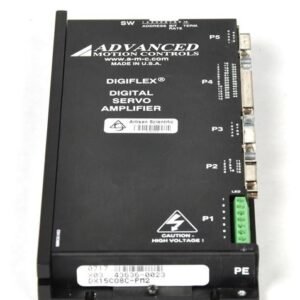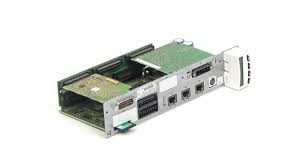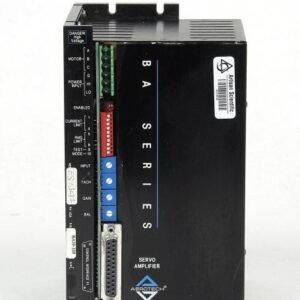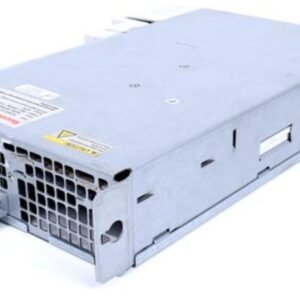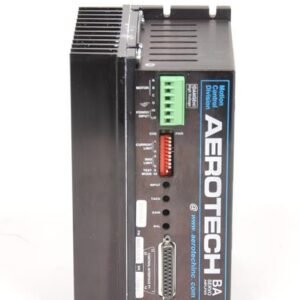

The OMRON / Delta Tau 603967-101 Geo Brick Drive Amplifier Board is an integrated motion control and drive solution combining a 32-axis Turbo PMAC2 motion controller with IGBT-based amplification. This board delivers pure digital DSP control over Brush, Brushless, and AC induction motors, eliminating analog signal dependencies and enabling higher closed-loop gains with reduced system complexity. The Geo Brick operates as a standalone machine controller with embedded PLC functionality or as a coordinated servo controller driven by external logic, making it suitable for scalable industrial automation architectures.
Technical Specifications
• Controller: 32-axis Turbo PMAC2 motion controller
• Drive Technology: IGBT-based amplification
• Motor Support: Brush, Brushless, and AC induction motors
• Servo Output: 4, 6, or 8 axes per board
• Control Signal: Digital PWM at up to 18 kHz (20 kHz reported in some configurations)
• Power Input: Single or 3-phase AC, 90–240 VAC; or DC, 12–340 VDC
• Output Current: 5A/10A or 8A/16A per axis; 15A/30A limit for axes 5–6
• Communication: Ethernet, USB 2.0 high-speed, Modbus TCP master/slave
• Encoder Feedback: Quadrature (A/B/Index), Sinusoidal, Resolver, Hiperface, SSI, Endat 2.1/2.2, Biss C/B
• Protection: Over-voltage, under-voltage, over-temperature (heat sink and IGBT), short circuit, overcurrent, input phase loss, shunt fault detection
• Shunt Configuration: Integral or external resistor support
– Key Features
• Digital PWM control eliminates traditional analog interfacing requirements
• Embedded PLC allows standalone machine logic execution
• Scalable from basic servo I/O control to full machine coordination
• Multiple encoder feedback types supported for diverse motor feedback architectures
• Comprehensive protection monitoring across thermal, electrical, and phase domains
– Typical Applications
Multi-axis industrial automation, precision motion systems, coordinated servo control, machine tool control with integrated logic, and motion platforms requiring 4- to 8-axis synchronization.
– Compatibility & Integration
The board interfaces via Ethernet and USB 2.0 for local program execution and supports Modbus TCP for distributed I/O and HMI integration. Low-voltage main power operation is supported.