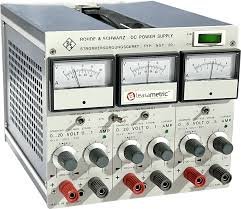

The Rohde & Schwarz NGT20 (117.7133.02) is a triple DC power supply delivering three independent, isolated outputs for simultaneous multi-device testing in development, manufacturing, and laboratory environments. Channels A and B serve linear IC applications with flexible series, parallel, and tracking operation modes. Channel C provides a dedicated 6 V, 5 A output optimized for digital IC supply. The unit combines high-resolution voltage setting via ten-turn potentiometers with fast regulation recovery—under 30 µs in voltage priority mode and under 50 µs in current priority mode—making it suitable for both standard and current-sensitive loads.
Technical Specifications
• Model: Rohde & Schwarz NGT20 (Order Number: 117.7133.02)
• Output Configuration: 3 independent, isolated channels
• Channel A & B: Linear IC supply; configurable in series, parallel, or tracking mode
• Channel C: 6 V, 5 A dedicated output for digital ICs
• Voltage Setting: High-resolution control via ten-turn potentiometers; 0.1 × maximum output voltage per turn (example: 2 V per turn on 20 V channel)
• Current Limiting: Rectangular characteristic with independent threshold setting per output; 10-division scale resolution
• Overvoltage Protection (Channel C): Continuously adjustable threshold from 4.5 V to 10 V; thyristor-shorted output on threshold breach
• Regulation Recovery: <30 µs (voltage priority mode); <50 µs (current priority mode)
– Key Features
• Short-circuit proof outputs across all channels
• Reverse current protection on all outputs
• Polarity protection integrated into all outputs
• Tracking operation enables proportional negative voltage adjustment relative to positive voltage
• Series connection supports higher voltage output
• Parallel connection supports higher current output
• High-resolution regulation with oscillation prevention
• Scaled potentiometers ensure reproducible current limit settings
– Typical Applications
• Linear and digital IC characterization and validation
• Multi-rail power delivery for complex circuit testing
• Current-sensitive device evaluation requiring fast transient response
• Simultaneous dual-supply testing with tracking or independent voltage control