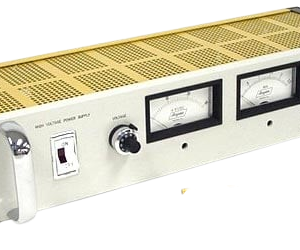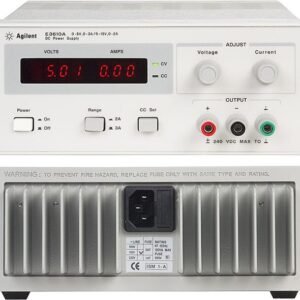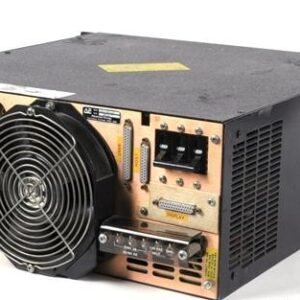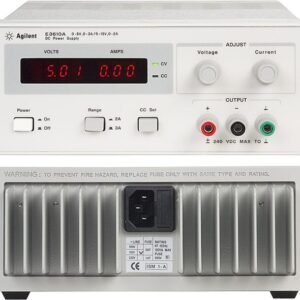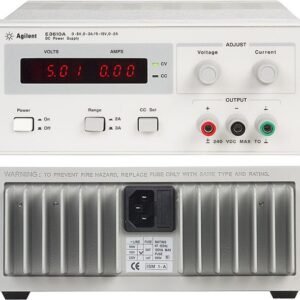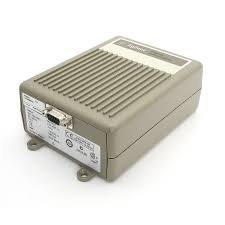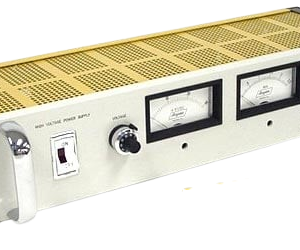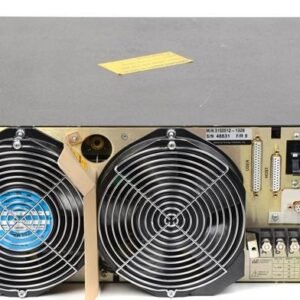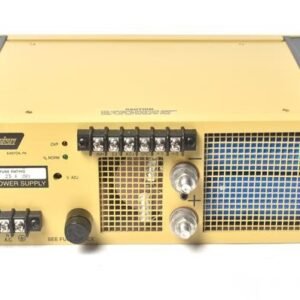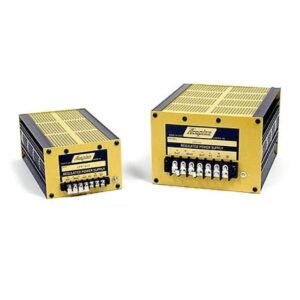

The Sorensen QRB20 is a DC power supply engineered for industrial and electronic testing applications. It delivers constant voltage and constant current operation with adjustable overvoltage protection, precise 10-turn potentiometer controls, and integrated LED indicators for real-time output monitoring. The unit employs zero voltage switching technology to achieve approximately 85% typical efficiency while minimizing noise. Remote sensing and programming capabilities support flexible system integration, with optional GPIB or RS-232 interfaces available for advanced control requirements.
Technical Specifications
Input Voltage: 105–125 VAC (model dependent; universal input versions accommodating 85–250 VAC also available in QRB series)
Output: Constant voltage / constant current (CV/CC) operation
Voltage & Current Control: 10-turn potentiometers for precise adjustment
Overvoltage Protection: Adjustable OVP
Efficiency: Approximately 85% typical
Switching Technology: Zero voltage soft switching
Metering: LED voltmeter and ammeter
– Key Features
• Dual-mode CV/CC regulation for battery charging, component testing, and power conditioning
• Adjustable output protection with independent OVP threshold control
• Direct front-panel metering eliminates external measurement equipment
• Remote sensing for load regulation at the point of use
• Optional GPIB/RS-232 interfaces for automated test systems and ATE integration
• Remote on/off control capability
• Compact footprint without sacrificing performance
– Typical Applications
• Electronics manufacturing and incoming component qualification
• Battery charging and conditioning
• Load testing of power conversion circuits
• Accelerated life testing and burn-in procedures
• Laboratory and field troubleshooting
– Compatibility & Integration
The QRB20 integrates into both standalone benchtop setups and networked test environments. Remote programming and sensing enable closed-loop control of output voltage and current independent of load resistance changes, critical for precision testing. Optional interface cards extend functionality to GPIB and RS-232 protocols, supporting integration with legacy and modern ATE platforms.