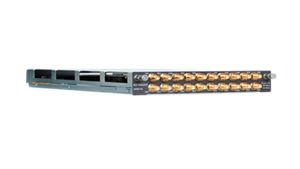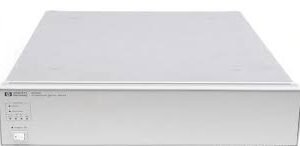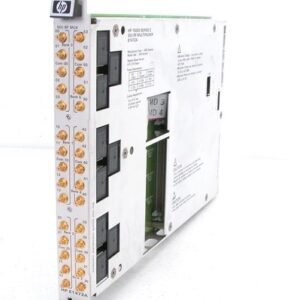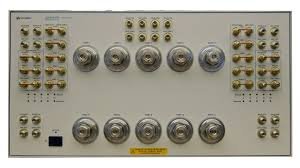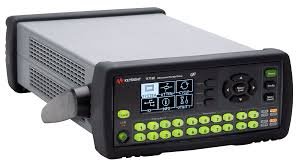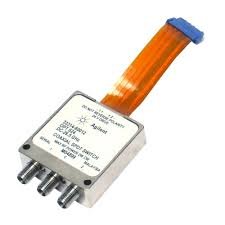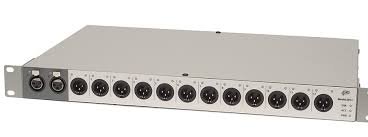

The Stanford Research Systems SR10, SR11, and SR12 switching systems are modular signal routers engineered to expand channel capacity in test and measurement setups. The SR10 routes any two of twelve balanced XLR inputs to outputs A or B; the SR11 connects inputs A or B to any of twelve balanced XLR outputs; the SR12 provides twelve unbalanced BNC channels configurable as input or output via internal jumper. All three employ high-isolation relays to achieve exceptional crosstalk performance—balanced models reach -155 dB at 20 kHz, unbalanced models -138 dB at 20 kHz—while maintaining series resistance below 300 mΩ. Units cascade via rear-panel connectors to form larger switch matrices, supporting up to 192 channels when integrated with the SRS SR1 Audio Analyzer. Computer control is available over GPIB, RS-232, and Ethernet interfaces, with cascading support for up to 16 switch boxes per control chain.
Technical Specifications
• Crosstalk Performance: SR10/SR11 (balanced): -155 dB @ 20 kHz, -137 dB @ 100 kHz; SR12 (unbalanced): -138 dB @ 20 kHz, -124 dB @ 100 kHz
• Series Resistance: <300 mΩ
• Maximum Signal Level: 250 Vrms, 220 Vp peak
• Maximum Power Handling: 5 W or 200 mA
• Power Consumption: <10 W
• Input Power: 90 VAC to 264 VAC, 47 Hz to 63 Hz
• Internal Protection: Fused
– Key Features
• Three model configurations: SR10 (balanced input), SR11 (balanced output), SR12 (unbalanced, configurable)
• High-isolation relay architecture for signal integrity
• Cascadable architecture with rear-panel (SR10/SR11) or BNC (SR12) connectors
• Up to 16 switch boxes per control chain via RS-232 or SR1 integration
– Interfaces & Control
• GPIB, RS-232, and Ethernet connectivity
• Ethernet control via socket interface or web page
• Native integration with SR1 Audio Analyzer
– Typical Applications
Audio analyzer channel expansion, multi-source signal routing, automated test matrices, and large-scale measurement system configuration.