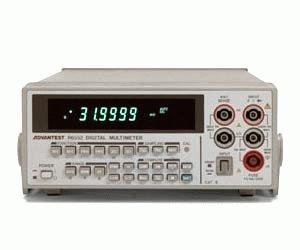
The Stanford Research Systems SR860 Dual Phase Lock-in Amplifier delivers synchronous detection from 1 mHz to 500 kHz with exceptional sensitivity and dynamic reserve approaching 150 dB. Built on advanced digital signal processing architecture, it combines a modern interface with flexible connectivity for precision measurements in complex signal environments.
Technical Specifications
Frequency Range: 1 mHz to 500 kHz
Voltage Input
• Switchable single-ended/differential JFET-pair amplifier
• Input impedance: 10 MΩ
• AC or DC coupling
• Noise: 2.5 nV/√Hz at 1 kHz (10 mV range); under 10 nV/√Hz at 10 Hz
• User-selectable shield termination: 10 Ω (ground) or 10 kΩ (float)
Current Input
• Built-in current amplifier with two ranges
• 1 µA range: 400 kHz bandwidth, 130 fA/√Hz noise
• 10 nA range: 2 kHz bandwidth, 13 fA/√Hz noise
Signal Processing
• Time constants: 1 µs to 30 ks
• Filter slopes: 6, 12, 18, 24 dB/octave
• Advanced Gaussian FIR and IIR filters; Gaussian FIR for improved rise-time and stopband attenuation below 3 s
• Harmonic detection: fundamental or harmonics up to 99th
• Harmonic rejection and distortion: −80 dB (100 kHz)
• Dynamic reserve: Nearly 150 dB (e.g., 3 × 10⁷ with 10 nV sensitivity and 300 mV input range)
• Gain accuracy: ±1 % (<200 kHz), ±2 % (to 500 kHz)
• CMRR: 90 dB at 1 kHz (DC coupled)
• Synchronous filter below 4 kHz with no output resolution loss
Reference Channel
• Internal and external reference modes
• Dual reference mode for difference-frequency detection
• Chop mode with direct digital PID control for optical choppers
• Internal precision oscillator; external sine or TTL signal lock
Analog Outputs
• CH1: ±10 V full scale (proportional to X or R)
• CH2: ±10 V full scale (proportional to Y and θ)
• X/Y rear panel: ±10 V full scale
• BlazeX: ±2.0 V full scale (low-latency X output or reference sync)
• Auxiliary: 4 BNC D/A outputs, ±10.5 V range, 1 mV resolution
• All outputs: 50 Ω source impedance
Reference Output
• Sine wave amplitude: 1 nV to 2 V
– Key Features
• Nearly 150 dB dynamic reserve for sensitive detection in noisy environments
• Dual-channel synchronous detection with independent X, Y outputs
• Flexible filtering: Gaussian FIR below 3 s for superior stopband rejection
• Up to 99th harmonic detection capability
• Low-latency BlazeX output for real-time feedback applications
– Typical Applications
Precision lock-in measurements in materials characterization, optical chopping systems, impedance analysis, and weak-signal recovery in noisy backgrounds.