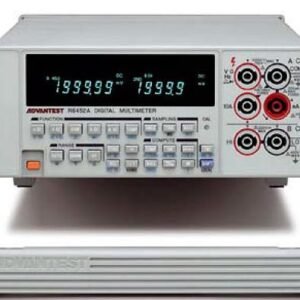

The Wayne Kerr ADU3210A is a precision automatic balancing bridge LCR meter engineered for accurate component impedance measurement across broad frequency ranges. It delivers high-resolution analysis of passive and active components in laboratory, research, and production environments. The instrument combines flexible measurement modes with 4-terminal Kelvin connectivity to eliminate lead inductance and contact resistance errors.
Technical Specifications
The ADU3210A measures inductance (L), capacitance (C), resistance (R), impedance (Z), dissipation factor (D), quality factor (Q), phase angle (θ), equivalent series resistance (ESR), DC resistance (Rdc), and transformer ratio. Frequency range spans 20 Hz to several hundred kHz, with extended capability to 1 MHz on selected ranges. Basic accuracy ranges from 0.05% to 0.1% depending on measurement parameter and frequency. Test signal levels are adjustable from millivolts to several volts (10 mV to 10 Vrms) with programmable drive levels for optimized measurement conditions.
DC bias current injection is supported for characterizing components under operational stress, from milliamperes to hundreds of amperes when used with external bias units. The instrument features a high-resolution color display for intuitive data visualization and quick result interpretation.
– Key Features
• Multiple measurement modes including L, C, R, Z, D, Q, and θ
• Graphing and analysis modes: frequency scanning, bias voltage sweep, bias current sweep, and time-domain acquisition
• Binning/sorting functions optimized for production quality control
• 4-terminal Kelvin connections for maximum accuracy
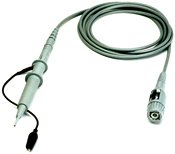
• Supports Kelvin clips, SMD tweezers, and dedicated component test fixtures
– Typical Applications
Component characterization in R&D and engineering environments. Production testing and component sorting. Passive component analysis under DC bias conditions. Transformer and inductor ratio measurement.
– Compatibility & Integration
Communications interfaces include GPIB (IEEE 488), RS232C serial, USB, handler interface, and analog voltage output. Standard AC power input 100–240 V, 50/60 Hz. 19″ rack-mountable configuration available alongside benchtop designs.