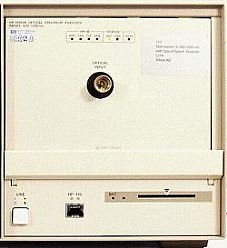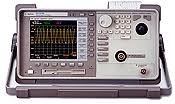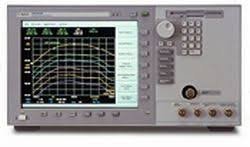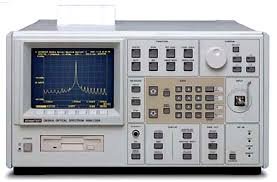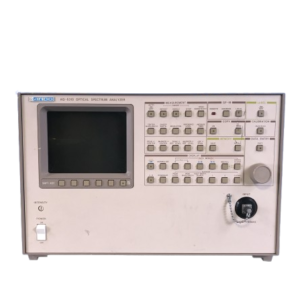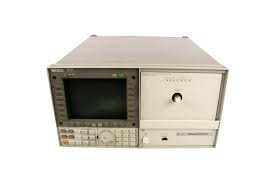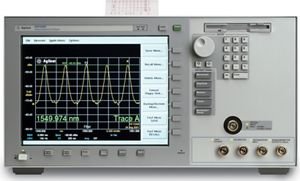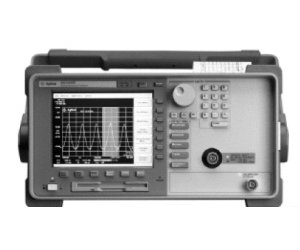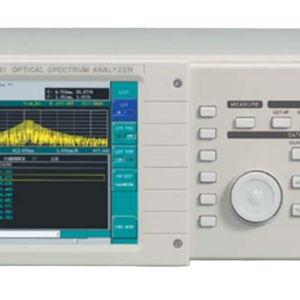

The Yokogawa AQ6377 is a high-performance optical spectrum analyzer for precise characterization across the 1900–5500 nm wavelength range. Using dispersive spectroscopy, it delivers measurements from –60 dBm to +13 dBm with 50 dB close-in dynamic range and wavelength accuracy of ±0.5 nm. The instrument features a free-space optical input for high coupling efficiency and maintenance-free operation, an integrated gas purge system to suppress water vapor absorption, and a built-in cut filter that removes high-order diffraction below 1500 nm. Wavelength resolution spans 0.2 nm to 5 nm across selectable display modes: wavelength (nm), frequency (THz), or wave number (cm⁻¹). Applications include environmental sensing, medical diagnostics, gas analysis, quantum cascade laser characterization, and advanced photonic research.
Technical Specifications
• Wavelength Range: 1900 nm to 5500 nm
• Wavelength Resolution: 0.2 nm to 5 nm (selectable)
• Wavelength Accuracy: ±0.5 nm
• Level Range: –60 dBm to +13 dBm
• Dynamic Range (Close-in): 50 dB
• Horizontal Scale Modes: Wavelength (nm), Frequency (THz), Wave Number (cm⁻¹)
• Wavelength Reference: Integrated acetylene absorption calibration with 0.6 picometer precision
– Key Features
• Free-Space Optical Input: Eliminates internal fiber maintenance; accepts both single-mode and multi-mode fibers with /PC or /APC connectors
• Double Speed Mode: Increases sweep speed up to 2× standard rate with 2 dB sensitivity penalty
• Gas Purge System: Nitrogen purging through dedicated ports reduces atmospheric water vapor effects
• Cut Filter: Suppresses incoming light below 1500 nm to eliminate high-order diffracted light
• Level Fluctuation Measurement: Tracks intensity variations over time at specific wavelengths for optical alignment and stability assessment
• Built-in Calibration: Requires no external calibration equipment
– Optical Input & Integration
• Fiber-optic coupling via /PC or /APC connectors to both single-mode and multi-mode fibers
• Free-space design ensures measurement repeatability without connector-induced losses
• HIGH1–3 sensitivity modes for extended dynamic range measurements