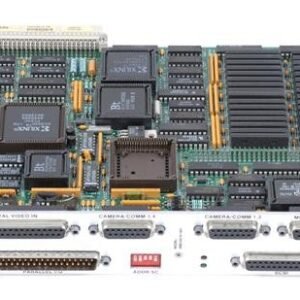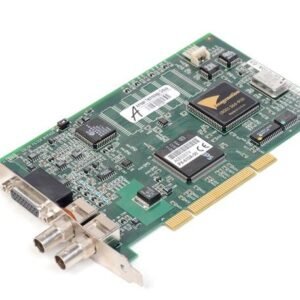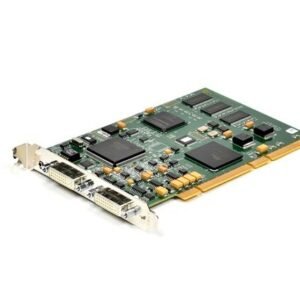

The Matrox 15350-00050 Genesis PMC Module is a high-performance graphics controller for embedded vision applications, integrating acquisition, processing, and display functions on a single PMC board. Built around a Texas Instruments TMS320C80 DSP and Matrox Neighborhood Operations Accelerator (NOA) ASIC, it delivers scalable performance up to 100 BOPs through optional cascaded Processor Boards. The module supports analog and digital video acquisition, real-time image processing, and high-resolution display output, with a Video Interface ASIC (VIA) managing data flow across acquisition, processing, display, and external I/O channels.
Technical Specifications
• Processing: TMS320C80 DSP with dedicated NOA ASIC
• Memory: Up to 64 MB SDRAM per processing node
• Bus: 64-bit at 400 MB/s
• Analog Video Acquisition: Up to 140 MHz sampling rate with three software-selectable modes—4 channel/8-bit at 35 MHz, 2 channel/8-bit at 70 MHz, or 1 channel/8-bit at 140 MHz; supports standard and non-standard component RGB with programmable A/D converters
• Digital Video Acquisition: 32-bit data at up to 40 MHz, configurable as four 8-bit, two 16-bit, or one 32-bit channel
• Display: Up to 1600 x 1200 at 85 Hz with true-color output and non-destructive pseudo-color overlay
• Scalability: Supports cascading up to six Processor Boards for increased processing performance
– Key Features
• Multi-format video input: color/monochrome, analog/digital, frame and line scan cameras
• Programmable A/D level, reference voltage, and clamping adjustments
• Line scan camera support for extended line lengths and variable line rates
• Parallel, pipeline, or combined multi-processing configurations
• External synchronization for RGB and monochrome camera inputs
– Typical Applications
• Real-time machine vision and industrial inspection
• Medical imaging and diagnostic systems
• Military and aerospace image acquisition and processing
• High-speed line scan capture and analysis
– Compatibility & Integration
The Genesis PMC architecture accommodates multiple Processor Boards to extend performance beyond the base module. RS-422/LVDS digital video acquisition requires an optional companion board.