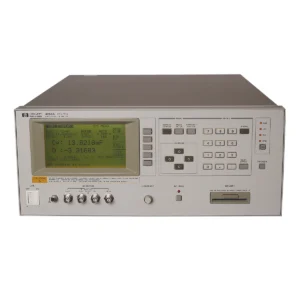

The Stanford Research Systems UGA100 is a benchtop quadrupole mass spectrometer for real-time gas mixture analysis across atmospheric pressure to ultra-high vacuum (UHV). It combines a wide operating pressure range with fast response time (< 0.2 seconds) and trace detection capabilities, making it suitable for semiconductor exhaust monitoring, glove box analysis, fuel cell studies, Freon detection, and pollution monitoring.
Technical Specifications
• Mass range: 100 amu
• Operating pressure range: Atmospheric pressure to UHV; RGA operates at 5 × 10⁻⁶ Torr
• Mass resolution: Better than 0.5 amu at 10% of peak height
• Detection limit: Less than 1 ppm
• Response time: < 0.2 seconds
• Spectrum acquisition time: Under one minute
• Individual mass measurement rate: Up to 25 ms per point
– Key Features
Inlet System
• Two-stage pressure reducing inlet for atmospheric sampling
• Vacuum inlet assembly for 10⁻¹ to 10⁻⁴ Torr range
• Direct RGA access for UHV applications (< 10⁻⁴ Torr)
• Sample inlet pressure: 1 mbar to 1 bar (⅛" Ultra-Torr® fitting)
• Flow rate: 1 to 10 mL/min at atmospheric pressure
• Capillary pressure range: Approximately 10⁻⁴ mbar to several bar
• Standard connections: Stainless steel & PEEK capillaries, two extra 2.75" CF ports
• Optional multi-capillary inlet with 16 valves
Detection & Control
• Dual detectors: Faraday cup and electron multiplier
• Built-in bakeout heaters for vacuum chamber, turbo pump connector, and vacuum inlet assembly up to 120 °C
• Front-panel and computer operation via Windows software
• Communication: RS-232 and Ethernet
• Software: Graphical interface, data analysis, valve/heater/pump remote control, analog and histogram scan modes, pressure-versus-time plots, leak detection, gas library
Environment
• Operates in highly corrosive gas environments (chlorine, fluorine) without damage to RGA or turbo pump
– Typical Applications
Semiconductor exhaust monitoring, glove box analysis, fuel cell studies, Freon detection, pollution monitoring, vacuum research and development.
– Compatibility & Integration
RS-232 and Ethernet interfaces enable remote operation and integration with laboratory automation systems. Windows-based software provides graphical control and analysis tools.