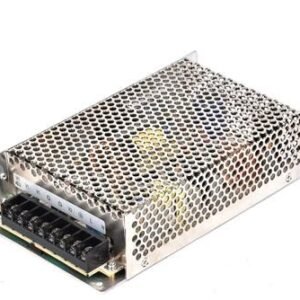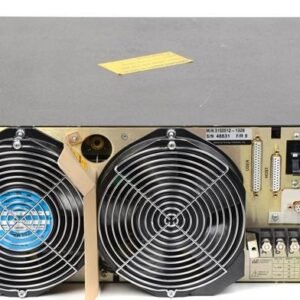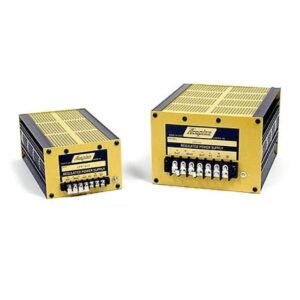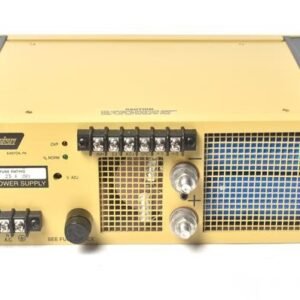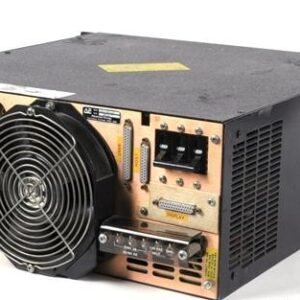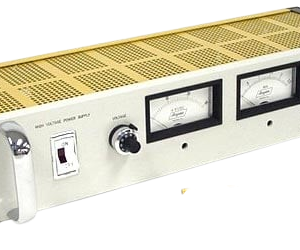
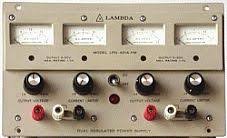

The Lambda / TDK / EMI LPD422A-FM is a dual-output regulated DC power supply engineered for laboratory, industrial, and commercial applications. It delivers two independent, continuously variable DC outputs spanning 0 to 40 VDC at up to 1 A per channel, with exceptional line and load regulation of 0.01% + 1 mV. The unit operates in constant voltage/constant current mode with continuously adjustable current limiting, short-circuit protection, and automatic safeguards against overvoltage and overtemperature faults. Front-panel analog meters provide simultaneous voltage and current monitoring for each output. Remote sensing and programming terminals enable precision applications requiring external feedback control. Convection cooling eliminates fan noise and maintenance concerns in sensitive measurement environments.
Technical Specifications
• Outputs: 2 independent DC channels
• Voltage Range: 0 to 40 VDC per output
• Current Range: 0 to 1 A per output
• Voltage Regulation: 0.01% + 1 mV (line and load)
• Ripple and Noise: 500 µVrms / 1.5 mVpp
• Current Limiting: Continuously adjustable with automatic activation
• AC Input: 105–132 VAC, 47–440 Hz (10% current derating at 47–53 Hz)
• Total Output Power: Approximately 80 W
• Cooling: Convection cooled
– Key Features
• CV/CC operation for constant voltage or current delivery
• Short-circuit proof design with no overshoot during power transitions
• Five-way binding posts for DC output connections
• Dual analog meters—voltmeter and ammeter per output
• Remote sensing and programming terminals for external control systems
• Compact footprint: 5 3/16″ H × 8 3/8″ W × 10 3/32″ D
– Typical Applications
Bench-top testing, circuit characterization, component qualification, and automated test systems requiring independent dual-channel power distribution with precise regulation.
– Compatibility & Integration
Rear-panel terminal blocks and five-way binding posts accommodate standard laboratory patch cords and test leads. Remote sensing terminals (3 and 7) support distributed sensing architectures for systems with significant wire-length voltage drop.