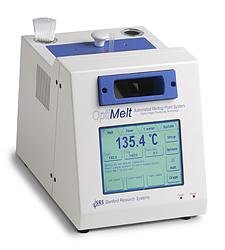

The Stanford Research Systems MPA100 Optimelt is an automated melting point analyzer for precise determination of melting temperatures and ranges in synthetic and analytical chemistry laboratories. Using the capillary method—compatible with all major pharmacopeial procedures—it analyzes up to three samples simultaneously with microprocessor-controlled temperature ramping, integrated digital image processing for automated melt detection, and a touchscreen interface. The system operates unattended, with results automatically recorded and displayed for review. It also functions as a general-purpose digital thermometer and timer.
Technical Specifications
• Temperature range: ambient to 400 °C (start: 10 °C above ambient to 396 °C; stop: start temperature + 4 °C to 400 °C)
• Temperature resolution: 0.1 °C
• Ramp rate: 0.1 °C to 20 °C per minute, adjustable in 0.1 °C increments
• Temperature accuracy: ±0.3 °C (up to 100 °C), ±0.5 °C (up to 250 °C), ±0.8 °C (up to 400 °C)
• Reproducibility: 0.2 °C
• Heat-up time: ~10 minutes (50 °C to 350 °C)
• Cool-down time: ~10 minutes (350 °C to 50 °C)
• Temperature sensor: precision platinum resistance thermometer (Pt RTD)
• Oven control: closed-loop PID
• Heating block: aluminum, optimized for fast heating and linear ramping
• Sample capacity: three simultaneous analyses
– Key Features
• Built-in high-resolution digital camera with real-time sample imaging
• Digital image processing for automated melt detection—superior to optical absorption or reflection methods
• Wide observation window with illuminated magnification lens for continuous visual monitoring
• Event tagging: up to six individual temperatures per sample via front-panel buttons
• Memory: 24 storable analysis methods; eight complete melting point reports
• USB port for computer control and data transfer
• MeltView software included
• Automatic Summary Report generation and storage
– Typical Applications
Precise melting point determination for pharmaceutical QA/QC, chemical purity assessment, synthetic compound characterization, and regulatory compliance testing requiring pharmacopeial-grade capillary methodology.